
Brazil at the start of a new historical cycle: sovereignty, BRICS and the challenges of multipolarity
Lula’s re-election, Vladimir Putin’s message and a stronger BRICS open a new cycle for Brazil–Russia relations. The Chamber’s president examines the opportunities, from SPIEF 2027 to artificial intelligence.
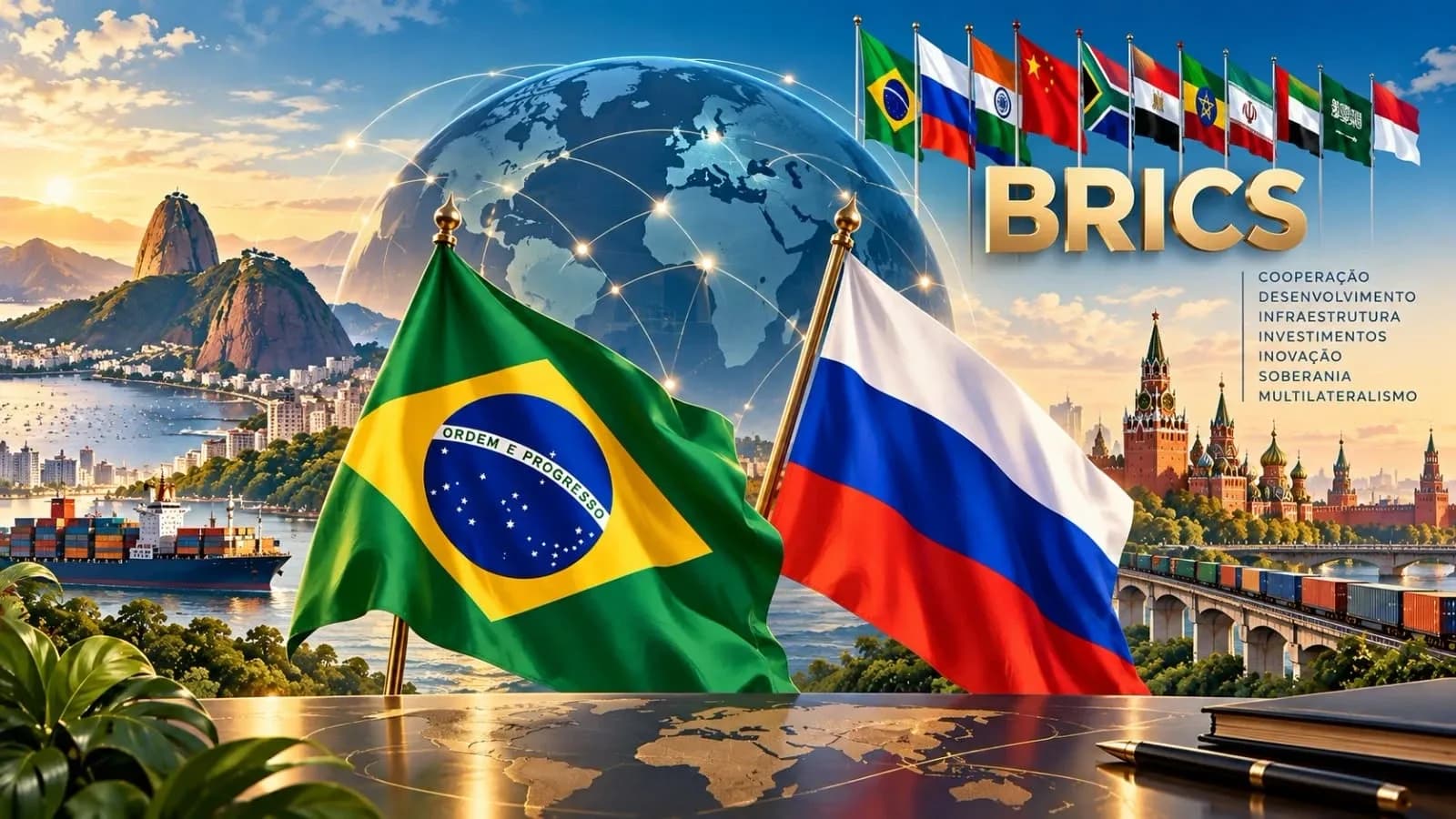
The re-election of President Luiz Inácio Lula da Silva on October 25, 2026, to a fourth term at the head of the Republic is an event of significant political and historical dimension. Its consequences reach beyond national borders and deserve to be examined in light of the profound geopolitical, geoeconomic and technological transformations that characterize the contemporary world.
More than the end of an electoral contest, the result opens a new cycle of responsibilities for Brazil, in an international landscape marked by the redistribution of economic power centers, the advance of strategic technologies, the reorganization of production chains and the growing participation of emerging countries in discussions on global governance.
The election also showed the growing importance of digital platforms and new forms of political communication. The flow of information, citizen participation and the shaping of public debate are being profoundly changed by digital technologies, a phenomenon that calls for attention to transparency, the quality of information and the responsible use of these tools.
The electoral result came in an environment of intense polarization and confirmed the importance of democratic institutions and of respect for a plurality of opinions. Political differences are legitimate and inherent to democracy, but they must not prevent institutional dialogue or compromise the continuity of initiatives aimed at national development.
From the perspective of international relations, we are particularly interested in understanding the opportunities that arise for Brazil's role in a changing world and for deepening strategic partnerships, among them the historic relationship with the Russian Federation.
Vladimir Putin's message and the strategic dimension of bilateral relations
Among the international statements that followed the election result, the message sent by the President of the Russian Federation, Vladimir Putin, to President Lula deserves special mention.
In congratulating him on his re-election, the Russian head of state highlighted his leadership qualities, his commitment to Brazil's sustainable socioeconomic development, and his defense of national sovereignty and of Brazil's legitimate interests on the international stage.
Putin also emphasized Lula's personal contribution to strengthening the strategic partnership between Brazil and Russia, expressing willingness to deepen bilateral cooperation and joint action in multilateral bodies and mechanisms, especially the United Nations, BRICS and the G20.
The content of the message reaffirms the importance the Russian Federation attaches to Brazil as an international interlocutor and to the continuity of a bilateral agenda with considerable potential for expansion.
Relations between Brazil and Russia cannot be reduced to passing political circumstances. They are relations between continental states, economies, societies, scientific institutions and business communities that, over decades, have built ties of complementarity and mutual interest.
It is precisely from this perspective that the Brazil–Russia Chamber understands its institutional mission, with responsibility and full commitment.
Thirty-eight years of experience: from the Soviet Union to the building of a new international order
My experience in economic and institutional relations between Brazil and Russia goes back to 1988, when I began working directly in foreign trade and in the maritime shipping of goods between the two countries.
At that time, the Soviet Union still existed. The world was structured around a bipolar logic, and international economic relations largely reflected the ideological and strategic divisions of the Cold War, then in its final phase.
As a professional in foreign trade and maritime transport, I witnessed the last years of that reality and the profound transformations that followed the dissolution of the USSR.
I saw new economic structures emerge, new mechanisms for business relations and new possibilities for cooperation. I also witnessed enormous difficulties, misunderstandings and opportunities wasted for lack of continuity, planning and mutual knowledge.
Over these nearly four decades, I have come to a firm conviction: relations between Brazil and Russia must be conducted with strategic vision, pragmatism, mutual respect and independence from party-political swings.
Governments come and go. International circumstances change. But the permanent strategic interests of countries and their peoples, their development needs and the opportunities for economic and technological cooperation remain.
History shows the importance of building diversified partnerships without giving up autonomy of decision or the defense of national interests.
In this sense, the current situation offers Brazil the possibility of expanding its international presence and turning diplomatic dialogue into concrete development projects.
BRICS as an instrument of economic and institutional transformation
The growing relevance of BRICS is one of the most important phenomena in international relations in the first decades of the 21st century.
The group, originally formed by Brazil, Russia, India and China, later joined by South Africa and further expanded, expresses the search for greater representation of emerging economies and countries of the Global South in the processes of international governance.
Its strengthening need not be interpreted as the replacement of one hegemony by another, nor as a project of isolation from Western economies.
The challenge is to build a more balanced, inclusive and representative international order, in which different centers of development can coexist, cooperate and negotiate on more reciprocal terms.
Multipolarity does not mean mandatory antagonism, but a plurality of interlocutors, autonomy of decision and broader possibilities for cooperation.
For Brazil, this perspective is especially relevant.
Our territorial size, the diversity of our productive structure, the availability of natural resources — including strategic minerals and rare earths —, our agro-industrial potential, our scientific and technological capacity and the importance of our domestic market give the country the conditions to play a bridging role between different regions of the world.
Cooperation within BRICS can contribute to trade diversification, infrastructure development, industrial modernization, food security, the energy transition and the creation of financial solutions suited to the needs of emerging economies.
It is essential, however, that this potential not remain confined to diplomatic declarations, but progressively turn into business initiatives, productive investment, knowledge transfer and measurable results.
From SPIEF 2026 to SPIEF 2027: a Brazilian agenda of opportunities
The experience accumulated throughout my career shows that the most consistent advances in international cooperation depend on the ability to turn institutional contacts into concrete projects, sustained by planning, financing and continuity.
This conviction was reinforced during my participation in the St. Petersburg International Economic Forum (SPIEF 2026), held from June 3 to 6, when I had the opportunity to represent the Brazil–Russia Chamber in a program of meetings, debates and business engagements, including with senior government officials.
I took part as a speaker on the international panel Russian Jurisdiction: Advantages for Foreign Investors, where issues related to the investment environment, economic integration and the institutional conditions needed to develop international business were discussed.
The mission also made it possible to deepen dialogue with financial institutions, government representatives, business organizations and entities responsible for promoting investment and economic cooperation.
Among these exchanges, I highlight the contacts with Vnesheconombank and with the Roscongress Foundation, which organizes the Forum.
The understandings reached in St. Petersburg reinforced the perception that there is room to expand Brazil's presence in the main venues of economic engagement in the Russian Federation.
In this context, the possibility was discussed of structuring a broader Brazilian participation in future editions of SPIEF, including through the creation of a pavilion dedicated to Brazil.
The next edition of the Forum, scheduled for June 2027, may offer an opportunity to advance this proposal, whose realization will depend on understandings with the organizers, the competent Brazilian institutions and potential participants.
A Brazilian space designed with strategic goals could bring together companies, state governments, financial institutions, universities, research centers and organizations representing different productive sectors.
More than an exhibition presence, the initiative could become a platform for presenting projects, attracting investment, promoting trade and developing technological partnerships.
Among the sectors with potential to take part are agribusiness, fertilizers, logistics infrastructure, energy, industry, biotechnology, artificial intelligence, digital technologies, sustainability, innovation and culture.
From political dialogue to concrete projects: financing, science, technology and infrastructure
The Brazil–Russia Chamber has argued that the bilateral relationship should be deepened well beyond traditional trade.
Although trade in agricultural products, fertilizers, raw materials and industrial goods continues to play a relevant role, a qualitative leap will depend on the ability to develop higher value-added projects.
Cooperation must be expanded in infrastructure, logistics, energy, industry, digital technologies, scientific research, professional training and innovation.
In this context, coordination between development finance institutions deserves special attention.
Brazil's National Bank for Economic and Social Development (BNDES) and the Russian development institution VEB.RF, historically associated with Vnesheconombank, are important references for discussing long-term financing instruments and project structuring.
To them is added the New Development Bank (NDB), known as the "BRICS Bank", whose work in financing infrastructure and sustainable development opens relevant possibilities for multilateral cooperation.
This is not a matter of assuming the existence of automatic joint financing mechanisms, but of advocating the creation of institutional channels capable of identifying viable projects, structuring guarantees, mobilizing investment and bringing public and private actors together.
Among the priority areas, I highlight the possibility of greater investment in Brazil in the energy and fertilizer sectors, the modernization of ports and logistics corridors, the expansion of railway infrastructure, the integration of transport systems, digital transformation and the promotion of academic relations.
The experience accumulated throughout my professional career shows that foreign trade is not sustained by agreements and expressions of goodwill alone.
It requires infrastructure, regulatory predictability, financing, logistical efficiency, knowledge of markets and, above all, trust between partners.
The same logic applies to technological cooperation and investment.
Artificial intelligence, digital sovereignty and sustainability: new frontiers of cooperation
The profound technological transformations under way pose an additional, strategic challenge for Brazil: expanding its capacity to develop, master and use advanced digital technologies, especially artificial intelligence.
Its growing presence in the economy, in communication, in scientific research and in international relations is changing productive structures and the ways society is organized.
The importance of artificial intelligence, however, goes far beyond the world of communication. Its application in industry, agriculture, health, logistics, education, defense, energy management and scientific research opens prospects of extraordinary economic and social reach.
In this context, I consider it essential that Brazil develop a strategy to strengthen its technological infrastructure, including the deployment of new data centers, the expansion of national high-performance computing capacity and the development of its own artificial intelligence systems.
Cooperation with the Russian Federation could make a relevant contribution to this process, through partnerships between companies, universities, research centers and development institutions.
Russian scientific and technological experience, including in computing, energy engineering, telecommunications and space applications, offers possibilities for knowledge exchange and joint projects.
Satellite technologies deserve special attention, including low Earth orbit communication systems, Earth observation, remote sensing and their applications in connectivity, environmental monitoring, precision agriculture and territorial planning.
Digital infrastructure, in turn, requires significant investment, energy availability, cybersecurity, data protection and the capacity for permanent technological upgrading.
It is equally indispensable to consider its environmental dimension.
The rapid growth of artificial intelligence and data centers comes with rising demand for electricity, cooling systems and water resources. The expansion of these structures must therefore be tied to energy efficiency, the responsible use of natural resources and the adoption of lower-impact energy sources.
In this field, Brazil has relevant advantages, particularly given the diversity of its energy mix and the potential for expanding renewable sources.
Russia, for its part, has experience in different power generation technologies, including nuclear, which could be part of a technical dialogue on reliable and environmentally responsible solutions, taking into account the applicable regulatory and energy security requirements.
Bringing these capabilities together must follow the principles of sustainability, economic viability and reciprocity, contributing to a digital economy compatible with environmental commitments and development needs.
BRICS is a relevant space for deepening this agenda, including through academic and scientific exchange, the training of specialists, technology development and the mobilization of financial instruments aimed at digital infrastructure.
Digital sovereignty should be understood as an integral part of the economic, scientific and technological sovereignty of states.
The Brazil–Russia Chamber can help bring institutions closer and identify concrete opportunities for cooperation in these sectors, encouraging investment, knowledge transfer, professional training and projects guided by sustainability criteria.
National sovereignty and multilateralism: complementary principles
The defense of national sovereignty occupies a central place in today's international debate.
In a world crossed by trade disputes, economic sanctions, geopolitical tensions and accelerated technological change, it is increasingly important to ensure that countries have the freedom to shape their development policies and establish their external partnerships.
Sovereignty, however, must not be confused with isolation.
A sovereign nation is one that can engage with different interlocutors, sign agreements compatible with its interests and take an active part in building international norms.
Besides Russia, China and the other BRICS members, Brazil should seek to maintain constructive relations with the United States, the European Union, and Latin American, African and Eurasian countries, always bearing in mind its strategic objectives.
Our diplomacy has a tradition of universalism that should not be abandoned.
Expanding relations with Russia and strengthening BRICS need not come at the expense of other partnerships. On the contrary, they can reinforce Brazil's capacity for negotiation, economic diversification and international projection.
That is precisely why multilateralism must be defended not only as an abstract principle, but as an effective instrument of peaceful coexistence, shared development and respect for the sovereign equality of states.
Democracy, disagreement and institutional responsibility
The 2026 presidential election took place in an environment of intense political and social polarization in Brazil.
Disagreement is part of democracy. What cannot be relativized is turning a political opponent into a personal enemy, nor replacing public debate with hostility, intolerance or attempts to delegitimize the voters' choice without objective grounds.
It is natural for the result of an election to bring satisfaction to some and frustration to others. Democratic practice requires, however, that winners and losers alike recognize the legitimacy of institutions and the freedom of every citizen to express their convictions.
Respecting plurality does not mean giving up one's own convictions, but defending them with responsibility, civility and openness to dialogue.
Throughout my career, I have always sought to distinguish the institutional work of the Brazil–Russia Chamber from individual party-political preferences.
Our organization is dedicated to strengthening economic, commercial, scientific, technological, cultural and institutional relations between two countries. Its mission transcends governments and must welcome interlocutors of different political orientations.
This does not prevent us, however, from recognizing that certain circumstances offer particularly favorable opportunities for deepening bilateral cooperation.
The continuity of dialogue between Presidents Lula and Putin, as well as the shared appreciation of BRICS and of multilateral platforms, is a relevant factor in assessing these prospects.
Recognizing it is an expression of institutional analysis and of consistency with the objectives that guide our work.
The Brazil–Russia Chamber should not be mistaken for a party-political organization. Its commitment to plurality is compatible with the defense of issues fundamental to its very reason for existing, such as international cooperation, the sovereignty of states and the promotion of sustainable economic development based on reciprocity.
From analysis to action: a concrete institutional agenda for the coming years
President Lula's fourth term will begin in a particularly complex international environment.
The transformations under way will demand capacity for diplomatic coordination, institutional stability, consistent development policies and initiatives able to strengthen the competitiveness of the Brazilian economy.
Brazil has the conditions to play a relevant role in this process, but the results will depend on the ability to turn possibilities into achievements.
We believe the new cycle of bilateral relations should bring opportunities to deepen dialogue between governments, financial institutions, universities, research centers, companies and representative organizations of society.
In light of these prospects, the Brazil–Russia Chamber intends to keep directing its work toward identifying concrete opportunities for cooperation, without limiting itself to following traditional trade relations.
The agenda we propose to develop includes deepening dialogue with development finance institutions, bringing companies and research centers closer together, encouraging industrial investment, modernizing logistics and energy infrastructure and incorporating new technologies into production processes.
We also include strengthening Brazilian participation in international economic forums, with special attention to the opportunities opened by SPIEF 2027.
The possible creation of a Brazilian pavilion at that Forum could become an instrument for bringing public and private initiatives together, provided it is accompanied by planning, defined objectives and the effective participation of interested private and governmental institutions.
This is not a list of commitments already made by governments or companies, but an identification of possibilities that deserve to be examined, coordinated and, where viable, turned into projects.
Our historical experience shows that solid international relations are not built on momentary, circumstantial and opportunistic affinities alone. They require continuity, knowledge, perseverance and a long-term strategic vision.
It is in this spirit that I welcome the start of a new Brazilian political cycle and President Vladimir Putin's message of congratulations: as elements of a context that offers opportunities, but that demands work, commitment, planning and concrete results.
In a world undergoing transformations of extraordinary speed and depth, Brazil must seek a leading role in its own development, preserve its sovereignty and contribute to a more balanced, cooperative and just international order.
The challenge before us is not only to strengthen BRICS or to expand relations between Brazil and Russia. It is to ensure that these initiatives effectively contribute to national development, shared prosperity and the building of a world in which the sovereignty of peoples is respected.
From traditional infrastructure to artificial intelligence, from trade cooperation to technological sovereignty, the future of Brazil–Russia relations will depend on the ability to turn an agenda of possibilities into concrete achievements.
This is the perspective that guides our work. And it is also the responsibility that this historic moment places upon us.
Rio de Janeiro, October 27, 2026
Gilberto F. Ramos — President of the Brazil–Russia Chamber